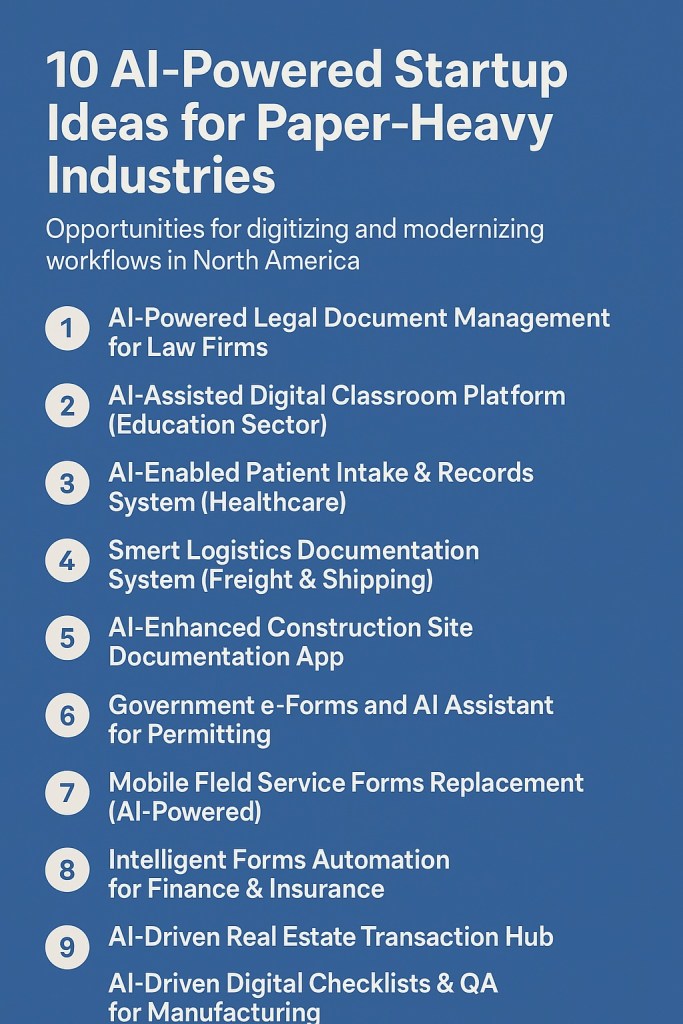
Below are ten startup concepts aimed at industries that still rely heavily on paper-based workflows. Each idea outlines the industry/use case, the pain points of paper reliance, the AI/web/mobile solution proposed, the target customers, and a possible monetization model.
Connect with zoril.la to build any one of these using our AI+ managed app development!
1. AI-Powered Legal Document Management for Law Firms

- Industry / Use Case: Legal sector (law firms, legal departments) with extensive paperwork (contracts, case files, court documents).
- Paper-Heavy Pain Points: Legal professionals handle enormous amounts of paper; a single lawyer can use 20,000–100,000 sheets annually . Many legal documents require physical copies or wet signatures, leading to duplicated files, high storage costs, and time-consuming manual searches. Physical filing and photocopying slow down case preparation and increase the risk of lost or misfiled documents.
- Proposed Solution: A cloud-based AI-driven document management platform that digitizes case files and contracts. The system would use OCR and NLP to scan and index legal documents, making them keyword-searchable and easy to retrieve. AI could automatically extract key clauses or dates from contracts and even generate summaries or first drafts of standard documents. Secure e-signature integration would handle client signatures electronically, and an AI chatbot could answer staff queries about document locations or case status. Mobile and web apps would allow attorneys to access files from anywhere, replacing the need to carry physical folders.
- Target Customer Segment: Law firms (from solo practitioners to large firms), in-house corporate legal departments, and court systems looking to modernize records. Early adopters might be mid-sized firms seeking efficiency gains.
- Monetization Model: B2B SaaS subscription (tiered by number of users or documents). The startup could charge law firms a monthly fee per attorney or per storage volume, with premium add-ons for advanced AI analytics or extra security compliance features. Enterprise licensing could be offered for large firms or government legal systems, possibly with setup and training fees.
2. AI-Assisted Digital Classroom Platform (Education Sector)

- Industry / Use Case: Education – schools and universities dealing with paper-heavy teaching and administrative tasks.
- Paper-Heavy Pain Points: Classrooms generate mountains of paper through in-class assignments, homework, tests, permission slips, syllabi, and more . Teachers spend hours printing materials and manually grading papers, while school offices handle paper forms for enrollment, report cards, and student records. This leads to inefficiencies, high printing costs, and difficulties in tracking or updating information (e.g., lost forms or delayed grade recording).
- Proposed Solution: An AI-assisted education workflow platform (web and tablet app) that digitizes both classroom work and school admin forms. Teachers can create and distribute assignments digitally, and students complete them on devices or online. An AI grading assistant can auto-grade multiple-choice or short-answer questions and even provide feedback on essays. For administrative needs, the platform offers digital permission slips and enrollment forms with e-signatures, eliminating physical handouts. AI-powered OCR could convert any handwritten submissions (or legacy paper records) into digital text. The system would integrate with school databases to update attendance, grades, and health records in real time, reducing manual data entry.
- Target Customer Segment: K-12 schools, school districts, and higher education institutions in North America aiming to reduce paperwork. Initially, tech-forward schools or private schools might adopt it, with potential expansion to public school districts and universities. Teachers and school administrators are key users, while students and parents use it for submissions and e-signing forms.
- Monetization Model: A hybrid B2B/B2C model. Schools or districts could pay an annual subscription or license fee based on number of students (e.g., a per-student per year fee). A freemium approach might allow individual teachers to use basic features for free (for a single classroom) to spur adoption, with schools paying for full-featured institutional accounts. Additional revenue could come from premium modules (advanced AI grading features, data analytics dashboards for administrators).
3. AI-Enabled Patient Intake & Records System (Healthcare)

- Industry / Use Case: Healthcare providers (clinics, hospitals, dental/vision offices) that rely on paper forms and records for patient intake, medical charts, and billing.
- Paper-Heavy Pain Points: Despite moves toward electronic health records, about 90% of healthcare providers still use paper and manual processes in daily practice . Patients often fill out repetitive paper forms on clipboards for each visit, and staff then must re-enter data into systems. Doctors may handwrite notes or prescriptions that require transcription. This paper shuffle causes delays, errors from manual data entry, and bulky filing for medical records. It also makes it harder to search patient history or share records between offices, impacting care coordination.
- Proposed Solution: A digital patient intake and records platform with AI features. Patients would use a tablet or web app to enter their information and medical history once, which auto-populates across all necessary forms (insurance, consent, etc.), eliminating redundant paperwork. An AI assistant can help flag missing information or inconsistencies in real time as patients fill forms. For clinicians, the platform offers voice-to-text transcription for notes (AI converts spoken notes to written records) and NLP that suggests ICD billing codes or drug dosage checks based on the note content. Legacy paper records can be batch-scanned; AI OCR extracts the text to integrate past history into the digital system. The platform could also use machine learning to analyze patient data for risk factors (helping providers focus on key issues) and facilitate secure record-sharing between referrals.
- Target Customer Segment: Outpatient clinics, doctor’s offices, and smaller hospitals that have not fully transitioned to electronic records due to cost or complexity. Also medical specialties with heavy form use (e.g. physical therapy intake forms, surgical consent forms). Medical office administrators and practitioners are the direct users, while patients interact via the intake interface.
- Monetization Model: B2B subscription model, possibly charging a monthly fee per provider or per location. The pricing could scale by practice size (number of practitioners or patients). An alternative model is a pay-per-usefor very small clinics (e.g., a fee per patient intake processed). Partnerships with insurance networks or hospital groups could provide the solution at scale, and premium features (advanced analytics, custom integrations with existing EHR systems) could be offered at a higher tier or one-time implementation cost.
4. Smart Logistics Documentation System (Freight & Shipping)

- Industry / Use Case: Logistics and transportation – trucking companies, freight forwarders, shipping lines – where shipping documents (bills of lading, manifests, customs forms) are still often paper-based.
- Paper-Heavy Pain Points: The shipping industry remains burdened with paper documents moving with the cargo. For example, roughly 40% of all container trade transactions still require physical paper bills of lading . A single international shipment might generate up to 50 sheets of paper exchanged among as many as 30 parties , including shippers, carriers, customs, and banks. This reliance on paper leads to frequent delays (e.g., cargo stuck at port awaiting documents), lost paperwork, and high admin costs. Manual data entry from forms (or re-keying information multiple times) increases errors in supply chain data.
- Proposed Solution: A smart logistics documentation platform that provides end-to-end digital document handling for shipments. This web/mobile solution would offer electronic Bills of Lading (eBOL) that are legally equivalent to paper, with secure digital signatures and blockchain-based verification for authenticity if needed. AI-driven OCR will read any paper documents received (from partners who haven’t gone digital yet) and auto-fill the corresponding digital forms in the system. The platform can use AI to cross-validate data – for instance, ensuring the cargo described on a customs form matches the bill of lading – and flag discrepancies before they cause problems. A conversational AI assistant could guide freight agents through complex customs paperwork by answering questions and checking compliance (reducing errors in filings). All stakeholders (shipper, carrier, port, customs, insurer) can access the documents through a cloud portal or app in real time, rather than exchanging physical copies. This speeds up clearance and reduces the chance of freight being held up due to missing papers.
- Target Customer Segment: Freight forwarders, logistics providers, and large manufacturers/exporters in North America that handle international and domestic shipping. Also trucking companies dealing with load manifests and delivery receipts, and maritime shipping firms keen on digitizing processes. Initial focus might be on mid-sized logistics companies looking for efficiency gains (as large ones may have in-house systems and very small ones might still be less tech-savvy). Adoption could extend to customs brokers and port authorities as integrated users for a network effect.
- Monetization Model: SaaS platform with transaction-based pricing. For example, charge a small fee per shipment or per document processed through the system (which at scale could save billions by preventing delays ). Alternatively, a subscription tiered by shipment volume (a logistics provider pays more if they process more shipments monthly). The startup could also offer premium integration services (connecting with ERP systems or global shipping networks) at an additional cost. Partnership pricing models might emerge (e.g., discounted enterprise deals with major shippers, or government contracts to digitize customs document handling).
5. AI-Enhanced Construction Site Documentation App

- Industry / Use Case: Construction industry – managing on-site documents like blueprints, work orders, safety checklists, and progress reports, which traditionally exist on paper.
- Paper-Heavy Pain Points: Construction projects generate an abundance of paperwork on-site . Crews often rely on large paper blueprints and printed project plans that can be outdated after design changes, leading to errors from building off old drawings. Daily reports, time sheets, and inspection forms are filled by hand, which is slow and prone to errors or loss. Manual, paper-based processes for things like time tracking and materials logs create inefficiencies and delays in project timelines . Additionally, carrying bulky plan sets and binders around the job site is cumbersome, and any update requires printing new copies for everyone, incurring cost and delay.
- Proposed Solution: A digital construction documentation app (for tablet and mobile) that replaces physical blueprints and forms with real-time digital equivalents, enhanced by AI. All project drawings and plans are uploaded to a cloud workspace; field workers use tablets to view the latest plans, with changes synced instantly so everyone works off the current version. AI vision can be employed to overlay 3D models or plan schematics on pictures of the site, helping identify if work is aligned to the plans or flagging discrepancies. The app includes digital forms for inspections, safety checklists, and daily logs, which crews fill out on their devices (even offline, syncing when back online). AI features assist by auto-completing repetitive fields (e.g., pulling project ID, dates, worker info) and validating entries (ensuring no required field is missed). A speech-to-text function allows supervisors to dictate notes or incident reports. The collected data populates dashboards for project managers in real time, eliminating the lag of turning in paper reports. All this reduces the paper “maze” and ensures instructions are up-to-date, improving accuracy and communication on the project.
- Target Customer Segment: Construction companies, general contractors, and subcontractors in North America aiming to modernize their field operations. Initial users could be mid-sized construction firms that need efficiency but lack a custom IT solution. Project managers and site supervisors would be primary users (ensuring crews adopt the app for daily use), and architects/engineers would use the digital plan component to issue updates. Also, specialty contractors (electrical, plumbing, etc.) could use it to track their field changes and reports in coordination with general contractors.
- Monetization Model: B2B subscription priced per project or per user. For example, a company might pay a fee for each active project on the platform (scaled by project size), allowing unlimited users on that project. Alternatively, a per-user per month fee for each field worker or supervisor using the app. The startup could offer enterprise plans for large builders (unlimited projects, volume discounts) and maybe a free tier for a single small project to encourage trials. Value-added services like custom integration with existing Project Management software or BIM tools could be an additional one-time fee or higher-tier subscription.
6. Government e-Forms and AI Assistant for Permitting

- Industry / Use Case: Government agencies (local, state, or federal) that require citizens and businesses to complete paper forms for services, permits, and applications.
- Paper-Heavy Pain Points: Public sector offices often still rely on paper forms and PDFs that citizens print out. Progress in digitizing these forms has been slow – in one review, only about 2% of federal government forms were fully online interactive forms, while 78% were merely fillable PDFs that often still need printing or lack mobile friendliness . This leads to long processing times (paper forms must be mailed or hand-delivered and then manually entered into systems by staff). Errors or missing information on forms are common and result in back-and-forth with applicants. The pandemic highlighted these inefficiencies when closed offices struggled with paper-based processes . Moreover, maintaining paper records is costly, and the lack of digital data hinders any analysis or cross-agency coordination.
- Proposed Solution: A government e-forms platform combined with an AI-powered virtual assistant to modernize public-facing paperwork. The core is a no-code form builder that lets agencies easily convert their paper/PDF forms into mobile-friendly, accessible web forms (compliant with e-signatures and privacy requirements). The AI assistant (chatbot) guides users as they fill out forms online, answering FAQs and checking for completeness — for example, it can prompt “You missed the date field, please fill that in” or clarify which documents need to be uploaded for an application. On the backend, submitted forms go straight into a secure database, and AI can categorize and route them to the right department workflow, eliminating clerical data entry. For legacy records, an OCR tool can scan incoming paper or faxed forms and extract data to integrate with the digital system, gradually reducing the paper backlog. The platform also supports generating a printable version with a QR code for any physical submission that might still be legally required, bridging the gap during transition. Overall, this solution speeds up service delivery and reduces errors by transforming how citizens interact with government paperwork.
- Target Customer Segment: Government agencies at the city or county level (e.g., for permits, business licenses, DMV forms), state departments, and eventually federal agencies looking to comply with digital government mandates (like the 21st Century IDEA law). Because selling to government can be complex, the initial focus might be on smaller municipalities or specific departments (such as a planning permit office or public health form system) that have autonomy to adopt new software. The end users are both the general public (using the digital forms) and the government employees who process the applications with the new system.
- Monetization Model: Primarily a B2G (business-to-government) model. The startup could use a subscription or licensing approach based on the size of the agency or number of forms processed per month. For example, a city might pay an annual license fee determined by its population or by number of form submissions handled. Another model is a software-as-a-service contract where the startup charges a setup fee plus ongoing maintenance. Given government budgeting, multi-year contracts or pilot programs could be common. The platform might also offer consulting services for form design or integration with legacy databases as a separate revenue stream. (In some cases, securing federal or state funding programs for digital government innovation could subsidize the cost for agencies.)
7. Mobile Field Service Forms Replacement (AI-Powered)
- Industry / Use Case: Field services – businesses with technicians or inspectors working outside the office, such as HVAC repair, appliance servicing, cable/internet installation, pest control, or maintenance inspection services.
- Paper-Heavy Pain Points: Many field service teams still rely on paper work orders, inspection checklists, and service reports. In fact, over half of companies (52%) continue to use manual methods for the bulk of field service tasks . Technicians often carry clipboard forms, then later re-enter data into a computer or turn in paperwork to the office, causing delays and data entry errors. Paper forms can be lost or damaged in the field (rain, dirt, etc.), and getting customer signatures on paper then scanning them is inefficient. Current software tools, where adopted, are sometimes slow or not user-friendly for technicians (45% of techs feel their tools aren’t fast enough ), leading some to stick with pen and paper. This all results in slower job completion updates, billing delays, and difficulty aggregating service data for analysis.
- Proposed Solution: An AI-enhanced mobile app for field service that fully replaces paper forms and streamlines on-site data capture. Technicians use the app on their smartphone or tablet to view their job orders, which include all customer details and tasks (no more printed work orders). The app provides digital checklists for each job type that the tech can tick off, and allows adding notes, photos, or audio comments. AI comes into play with features like image recognition – for example, a technician can snap a photo of equipment serial number or model, and the app’s AI auto-identifies it and pulls up the relevant service history or checklist for that model. The app could also offer a voice assistant so the tech can dictate notes or findings (which the AI transcribes to text). For compliance or detailed inspections, the AI can ensure all required fields are completed before the technician can close a job, reducing oversights. As soon as a job is finished, the customer can sign on the device screen, and a digital report is instantly sent to both the customer and the central office. This real-time sync means no waiting for paperwork to return; billing and inventory updates can happen immediately. Managers get a live dashboard of field operations, and AI analytics can be applied on the collected data to spot patterns (like frequently failing parts or technicians who might need more training on certain tasks).
- Target Customer Segment: Companies in field service domains that have not yet fully digitized their workflow. This includes small-to-mid size service contractors (plumbing, electrical, HVAC companies with a few dozen technicians) as well as larger enterprises with extensive field teams (utility companies, telecom service providers). The app would be used by field technicians and their dispatchers or managers. To gain traction, the startup might target a niche first – for example, an app tailored for HVAC maintenance businesses – then expand to adjacent service industries using similar tech.
- Monetization Model: A straightforward B2B SaaS subscription, likely per user (per field technician) per month licensing. For instance, a company would pay a monthly fee for each active technician account on the platform. Volume discounts could encourage larger deployments. There could also be a tiered model: a basic plan for small teams (with core digital forms and reporting) and higher tiers that include advanced AI features (image recognition, analytics) and API integration into the company’s CRM/ERP. Another revenue angle is partnering with insurance or equipment vendors to sponsor or integrate with the platform (e.g., providing discounts if service data is shared, though this would require careful handling of data privacy).
8. Intelligent Forms Automation for Finance & Insurance
- Industry / Use Case: Financial services (banks, credit unions, loan providers) and insurance companies, which handle countless forms for account opening, loan applications, policy documents, and claims – many still on paper or PDF.
- Paper-Heavy Pain Points: Despite digital banking in many areas, financial institutions remain tied to physical paperwork for certain transactions due to strict regulations. Many forms (mortgage applications, insurance claims, new account setups) require multiple pages of wet signatures and supporting documents. Regulations often mandate physical copies or notarized documents, meaning even if data is collected online, paper printouts get involved . This results in slow processes (e.g., mortgage closings with stacks of paper to sign), high mailing and storage costs, and potential errors when staff must re-type information from handwritten forms. Compliance checks (KYC, identity verification) are often manual, reviewing photocopied IDs and documents. Overall, customers get frustrated with lengthy paperwork, and institutions incur costs in processing and compliance.
- Proposed Solution: An AI-enabled digital form and compliance automation system for finance and insurance. This solution would provide customers a web/mobile portal to complete all necessary forms digitally, with guidance. A dynamic form interface would only show relevant sections based on user inputs (streamlining the experience compared to one-size paper forms). Built-in AI verification can OCR-scan uploaded IDs or documents (like pay stubs, tax forms) to extract data and check authenticity, flagging any issues (e.g., expired ID, missing signature). The system also uses e-signature and secure digital ledger technology to satisfy legal requirements for signatures, aiming to replace “wet” signatures wherever regulations have evolved to accept digital. For internal operations, an AI workflow engine automatically routes the completed application or claim to the right department and runs fraud detection algorithms on the data (for example, cross-checking a claim against known fraud patterns). If any step still absolutely requires paper (due to law), the platform generates a ready-to-print packet with all entered data, barcodes, and instructions to minimize any manual effort. The use of AI greatly speeds up compliance: e.g., it can instantly check that a loan application has all required fields and documents before submission, or an insurance claim has the necessary incident photos, reducing back-and-forth. Overall, this cuts processing time from days to potentially minutes for straightforward cases.
- Target Customer Segment: Banks (particularly regional banks and credit unions that need an off-the-shelf solution), mortgage lenders, and insurance companies in North America. Also, fintech companies that partner with banks/insurers could use this as a backend service. Initially, mid-sized insurance firms or financial institutions might be ideal clients, as big banks often have in-house systems (though they might adopt specific modules like the AI OCR for compliance). The end users include the institutions’ customers (who will appreciate a smoother digital onboarding or claims experience) and the back-office staff (whose data entry and verification workload would drop).
- Monetization Model: B2B SaaS, likely priced by volume of transactions. For example, a bank might pay based on the number of applications or forms processed each month (with a base platform fee). For insurance, it could be number of claims processed. Another model is enterprise licensing: an annual fee based on organization size or assets, granting unlimited use (this might appeal to larger clients). The startup could also consider a transaction fee model, especially for smaller clients – charging a few dollars per completed loan application or per insurance policy processed, aligning cost with usage. Emphasizing the ROI (e.g., reducing processing cost per document) will help justify the fees.
9. AI-Driven Real Estate Transaction Hub
- Industry / Use Case: Real estate sector – handling the documentation for property transactions, rentals, and property management which traditionally involves extensive paperwork.
- Paper-Heavy Pain Points: Real estate deals are infamously paper-intensive. From property deeds and purchase agreements to inspection reports and closing disclosures, each transaction produces a stack of documents for buyers, sellers, agents, and lenders . Even with e-signature technology available, many processes still require in-person steps (notarizations, original copies for records). Keeping track of all these forms and ensuring every party has signed in all the right places is cumbersome. For rentals and property management, leases and incident reports are often on paper, leading to filing cabinets full of tenant files. The persistence of paper means delays in closings (overnight mailing of contracts), difficulty coordinating between multiple stakeholders (buyers, sellers, multiple agents, mortgage brokers, attorneys), and a risk of errors in transferring information from one document to another. The COVID-19 pandemic forced some virtualization, but there’s still significant opportunity for more deliberate digital workflows .
- Proposed Solution: An integrated real estate transaction platform that centralizes all documents and tasks in a property deal, with AI assistance for accuracy and speed. All parties (buyers, sellers, agents, lenders, attorneys, inspectors) collaborate through a secure web portal that replaces email threads and paper exchange. The platform auto-generates standard documents (offer letters, contracts, closing forms) from templates when prompted, filling in known data (property address, names, prices) to avoid retyping. AI algorithms double-check documents for completeness and consistency – for instance, ensuring the sale price is the same on the purchase agreement, loan documents, and escrow instructions, flagging any discrepancies before they cause legal issues. Throughout the transaction, an AI assistant could serve as a virtual transaction coordinator, sending reminders to parties to sign or complete tasks (“Buyer’s agent, the inspection report is ready for your review”), and answering simple questions (using a knowledge base of real estate FAQs or specific deal data). For property management use, the system handles digital lease signing, rent receipts, and even AI chatbots for tenant inquiries or maintenance requests, creating a paperless rental file. All signed documents are stored digitally with an audit trail; crucially, if a wet-ink notarization is needed, the platform can integrate remote online notarization services where legal, or guide the user through printing just the necessary pages. By providing a one-stop digital hub, the solution greatly cuts down on printing, scanning, and emailing documents, accelerating closing times and reducing errors.
- Target Customer Segment: Real estate brokerages and title/escrow companies in North America would be primary customers, as they can deploy the platform across all their agents and transactions. Independent realtors and real estate teams could also subscribe to manage their deal pipeline. Additionally, property management firms could use the lease and tenant management features. Key end users include real estate agents (who initiate and manage transactions on the platform), transaction coordinators, and clients (buyers/sellers or tenants/landlords) who access and sign documents. By providing a superior client experience, agents and brokers have incentive to adopt it.
- Monetization Model: Subscription-based, with a per-transaction or per-user pricing model. One approach: brokerages pay a monthly fee per agent using the system (or per office), possibly with a cap on number of active transactions. Another approach: charge per completed transaction (e.g., a fixed fee added into closing costs for the digital service). For property management, a monthly fee per unit or per property managed might be viable. The startup could also offer a freemium individual plan (for a single agent handling a few deals, free up to X transactions) to drive adoption, converting heavy users to paid plans. Ancillary revenue might come from partnerships (for instance, integrating mortgage lenders or insurance providers and taking a referral commission, or charging for premium add-ons like advanced analytics on brokerage performance).
10. AI-Driven Digital Checklists & QA for Manufacturing
- Industry / Use Case: Manufacturing (factory floors and production plants) where many operational logs, quality assurance (QA) checklists, and work instructions are still maintained on paper.
- Paper-Heavy Pain Points: In many factories, especially those slower to adopt Industry 4.0, frontline operations rely on printed checklists and handwritten logs for everything from machine maintenance records to production tallies. Indeed, most factories still use paper-based checklists, notebooks, or even whiteboards to track daily tasks . These manual processes don’t scale well: they are slow, offer no real-time visibility, and data from them is hard to aggregate for insights. Paper-based recording means if an issue is noted by an operator, management may not see it until forms are turned in, potentially missing the chance to react quickly. Human errors (missed steps on a checklist or illegible handwriting) can lead to quality defects or safety incidents. Additionally, compliance in manufacturing (ISO standards, OSHA safety logs) often involves heaps of paperwork that auditors must sift through, which is inefficient.
- Proposed Solution: A digital manufacturing checklist and QA system with AI integration. On tablets or rugged handheld devices, factory operators access all their routine checklists (startup/shutdown procedures, quality inspection forms, maintenance schedules) in a digital format. The interface is user-friendly with large buttons and offline capabilities (in case of limited connectivity on the shop floor). As an operator goes through a task, the app ensures each step is confirmed and can require photo evidence or sensor verification for critical checkpoints (for example, attaching a photo of a gauge reading, or the system pulling data from a machine sensor to auto-verify a temperature). AI plays a role by monitoring these inputs: it can detect if a value entered is out of normal range and alert the operator or a supervisor immediately, preventing a defect or downtime. Over time, the AI can analyze all collected data to identify patterns – e.g., it might predict when a certain machine is likely to fail based on small gradual deviations in daily checks, enabling preemptive maintenance. The system also provides real-time dashboards in the plant and management offices: no more waiting for end-of-shift paper reports. In terms of quality compliance, the digital logs are searchable and easily compiled for audits, with AI able to automatically generate compliance reports or highlight sections of interest for an auditor. By eliminating the paper and having AI assist with anomaly detection and data entry (like auto-filling known values, timestamps, etc.), the solution improves efficiency, accuracy, and response time in manufacturing operations.
- Target Customer Segment: Small to mid-sized manufacturing companies in North America that are embarking on digital transformation but need a practical first step. This could include food processing plants, electronics assembly shops, or automotive parts suppliers – anywhere that checklists and routine inspections are crucial. Larger enterprises could also use it on specific lines or plants not yet integrated into their big ERP/MES (Manufacturing Execution System). Primary users are plant floor operators, line supervisors, and quality engineers, while plant managers and execs benefit from the aggregated data and alerts. To gain traction, the startup might target an industry with strong compliance needs (like pharmaceuticals or aerospace manufacturing suppliers) where the cost of errors is high and paperwork is especially burdensome.
- Monetization Model: B2B enterprise software model, likely per-site or per-seat licensing. For example, charge an annual license per production line or per facility, which allows unlimited operators at that site to use the system. Alternatively, charge per user (operator) per month if the number of users is more predictable. The value proposition (reducing downtime, improving quality) can justify significant ROI-based pricing. The startup could also offer hardware bundles (pre-configured tablets or industrial devices with the software) for an upfront fee. In addition, a setup/training fee might be charged for initial deployment, and ongoing premium support could be a paid add-on. Over time, as the platform collects industry-wide data (if permissible), there might even be an opportunity to offer benchmarking analytics as a subscription service across different clients (anonymized insights).
Each of these startup ideas targets a sector where paper use is still prevalent and outlines how digital tools coupled with AI can bring about meaningful transformation and efficiency gains. By focusing on the specific pain points of paper processes in each industry, these solutions aim to modernize operations, reduce errors, and speed up workflows — unlocking value in sectors long overdue for digital innovation.
 Zorilla | The AI Agency | Blog